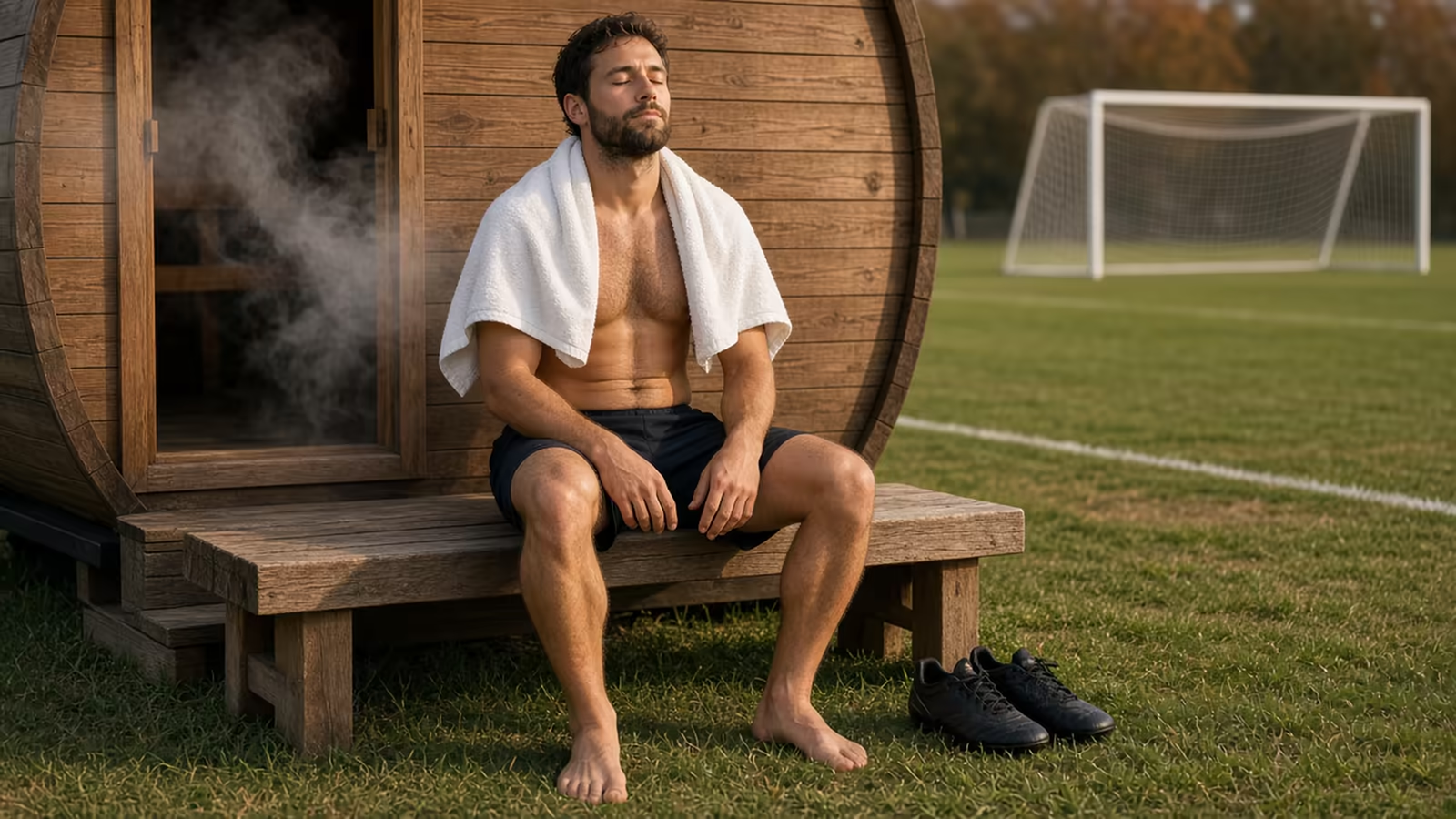
A sauna or hot bath after training may ease muscle soreness and improve how recovered players feel, but studies do not show that it brings performance back faster. The strongest case for heat lies elsewhere: in several small studies, regular post-exercise sauna increased blood volume and endurance performance in runners. A systematic review of 14 studies (Ahokas et al., 2025, PMID 41032138) rated the quality of this evidence as low to moderate, so a sauna is best treated as an add-on with a specific purpose, not a recovery miracle.
Last week we wrote about the ice tub. Today, the other side of the door: a wooden bench, 80 degrees, a towel over the shoulders. Plenty of footballers end training this way and say their legs “feel lighter” afterwards.
The question is whether that is just a pleasant feeling or something you can measure. And why, in heat as in cold, it all starts with breathing.
Key takeaways
- Recovery after a single session, uncertain. Of 9 studies on the acute effect of heat, 4 showed no difference, 4 showed a benefit and 1 showed a negative effect (Ahokas 2025).
- Perception, probably yes. In 16 basketball players, 20 minutes of infrared sauna after strength training reduced soreness and limited the drop in jump performance the next day (Ahokas 2023).
- Endurance, promising but small studies. Three weeks of post-training sauna increased plasma volume by 7.1% in runners (Scoon 2007), while a meta-analysis of 10 studies rated the certainty of evidence as low to very low (Solomon 2025).
- Sleep, a warm bath 1-2 hours before bed helps. Water at 40-42.5°C improved sleep quality and shortened the time to fall asleep (Haghayegh 2019).
- Heat speeds up breathing. Strong heating triggers hyperventilation and a drop in CO2, but conscious breathing control almost abolished it (Tsuji 2019).
What does a sauna do to your body after training?
First it adds stress. Only later does it help you settle down.
In 6 well-trained cyclists who sat in an 87°C sauna for 30 minutes after training, heart rate rose by about 32% between the first and last 10 minutes, and the vagally mediated HRV index dropped by about 62% (Leicht 2018). For the body, that is not rest. It is another load, just without movement.
It gets more interesting after you step out. In a study of 93 people (mean age 52), after 30 minutes in a 73°C sauna and 30 minutes of cooling down, resting heart rate was lower than before the sauna: 68 versus 77 beats per minute. During the cool-down, parasympathetic activity, the branch of the nervous system responsible for rest, increased (Laukkanen 2019). These were not athletes, so carrying the numbers over to footballers needs caution.
One more detail cools the enthusiasm. In an 8-week randomised trial, adding 15 minutes of sauna after exercise did not improve HRV any more than exercise alone (Lee 2025).
So the sauna briefly revs up the nervous system, and the calming effect only arrives during the cool-down. How the return to calm after exercise works without heat or cold is covered in our article on how to calm the nervous system after training.
Does a sauna speed up recovery after a match?
The studies do not give one answer. They are more convincing on perception than on hard performance data.
The systematic review by Ahokas et al. (2025) covered 14 studies and 194 participants. Of the 9 studies on the acute effect of post-exercise heat, 4 showed no difference, 4 showed a benefit and one showed a negative effect. The authors state plainly that the current data do not allow definitive conclusions.
One of the more promising studies involved team sport players. 16 basketball players completed a maximal strength and plyometric session, then spent 20 minutes either in an infrared sauna (around 43°C) or resting passively. After the sauna, the drop in jump performance 14 hours later was smaller, muscle soreness was milder and perceived recovery was better. Night-time heart rate and HRV did not differ between conditions (Ahokas 2023).
In 10 active men, 30 minutes in an infrared sauna after strength training changed nothing compared with no sauna. After a maximal endurance session, the jump 30 minutes later was slightly higher: 34 versus 32 cm (Mero 2015).
The most recent randomised study in 40 people compared hot water (30 minutes, 42°C), hot air, cold water and simple rest after muscle-damaging exercise. At 72 hours, strength had returned to 88-89% of baseline in the heat and no-treatment groups and to 82% in the cold water group, but the differences were not statistically significant. A marker of muscle damage normalised fastest after hot water. No treatment resolved soreness within 72 hours (Bayne 2026).
Is heat just a placebo?
It may be, to a large extent. And that comes from a study in footballers.
Gustafsson et al. (2025) assigned 40 young national-level footballers to three groups after a simulated match: hot water (42°C, 20 minutes), cold water or a sham laser treatment. Recovery of sprint, jump, strength and endurance was similar in all groups. Using the chosen method for 15 weeks did not change performance development either.
We covered the same study in our article on cold water immersion and recovery. The conclusion fits both: part of the effect of sauna and ice may come from players believing in the treatment and feeling better afterwards. That counts too. You just need to know what you are paying for.
Does regular sauna use improve endurance?
This is where heat has its most interesting data. The studies are small and mixed, though.
Scoon et al. (2007) gave 6 runners three weeks of post-training sauna, about 31 minutes at around 90°C, on average 13 times. Run time to exhaustion increased by 32%, which the authors estimated as roughly a 1.9% improvement in a time trial. Plasma volume rose by 7.1%, and the change in performance was strongly linked to the change in blood volume.
In 20 middle-distance runners, three weeks of post-training sauna (about 28 minutes at 101-108°C, around 3 times a week) improved VO2max and speed at a 4 mmol/L blood lactate concentration more than training alone (Kirby 2021). In 10 well-trained runners, five weeks of hot water immersion (5 sessions of 45 minutes per week, at least 40°C) increased haemoglobin mass by 33 g, blood volume by 284 mL and VO2max by 2.7 mL/kg/min (Jenkins 2025).
But there is another side. In 16 cyclists, six days of hot water immersion after training did not change time-trial performance (Kjertakov 2026). A meta-analysis of 10 studies and 199 participants found a trivial effect on performance in both hot and temperate conditions, a small effect on VO2max, and low to very low certainty for every outcome (Solomon 2025).
For a footballer this distinction matters. The research is mostly on runners and cyclists, not on sports with constant changes of pace. A broader review by Chaillou et al. (2022) concludes that data on heating as a recovery method are limited, although the direction for endurance and sprint exercise looks promising.
Does an evening sauna help you fall asleep?
A warm bath before bed has the best data here. Post-training sauna is only starting to be studied from this angle.
The meta-analysis by Haghayegh et al. (2019) pooled 17 studies. A bath or shower at 40-42.5°C was associated with better self-rated sleep quality and higher sleep efficiency, and when taken 1-2 hours before bed, even for 10 minutes, it shortened the time to fall asleep. The authors explain this by heat widening blood vessels in the hands and feet, after which the body sheds heat faster and lowers its core temperature.
A 2026 review focused on athletes (Miliotis et al., 2026) points to a similar mechanism, but notes that it is still unclear whether post-exercise heat improves sleep through the nervous system or through reduced muscle soreness. In the basketball study, a single sauna session did not change night-time heart rate or HRV (Ahokas 2023).
The practical takeaway is simple: leave a gap. A sauna right before getting into bed still means an elevated heart rate. Cold close to bedtime, according to Miliotis et al., may make sleep harder.
How does heat change your breathing?
In a mild sauna, not much. Under strong heating, very clearly.
An older review by Finnish researchers reports that ventilation changes only slightly in a typical sauna, by about 10% (Laitinen 1988). The authors advise avoiding the sauna during acute respiratory infections.
It is different when core temperature rises sharply. Tsuji et al. (2019) heated 10 healthy men until their oesophageal temperature reached 39°C. Once it passed about 38°C, breathing became noticeably faster and deeper. This is heat-induced hyperventilation. At 38.6°C, participants breathing freely moved 25.6 L of air per minute, while those who consciously kept their breathing at the level seen early in heating moved only 11.9 L. The difference showed up across the body:
- end-tidal CO2: 24.7 mmHg with free breathing versus 39.5 mmHg with controlled breathing,
- blood flow velocity in a brain artery: 44.9 versus 60.2 cm/s,
- work of breathing at the end of heating: 59.4 versus 16.1 J/min.
The authors write that voluntary breathing control can nearly abolish heat-induced hyperventilation and limit the drop in CO2 and brain blood flow. Why CO2 matters for athletes is something we explore in our article on CO2 tolerance and athletic performance.
To be honest: this was a lab study with very strong heating, not a normal post-training sauna. We did not find studies in PubMed testing whether controlled breathing in a sauna improves recovery in footballers. What we do know is that the body in heat tends to over-breathe, and calm breathing can largely switch that response off. Cold water works in a similar way, as we describe in our article on cold water immersion and recovery.
Why is breathing in the heat a skill?
Because in the heat it is easy to slip into fast, shallow mouth breathing without even noticing. And that is exactly the pattern that costs the most on the pitch.
At AirFlow Performance we treat calm nasal breathing as a skill that players first build in easy conditions and then carry over to situations where the body is under pressure: after a sprint, after a match, in cold water and in the sauna. The role of the nose in slowing breathing down is covered in our article on nasal breathing after exercise. How we structure it over time is shown in our three-stage breathing training programme, and what we measured in the 7-week pilot at Lech Poznań is on our results page. For more on breathing physiology, see our science section.
Sauna or cold water?
It does not have to be a choice. Each has a different strength and a different weak spot.
Cold water has better documented effects on soreness and HRV right after exercise, but used regularly after strength training it may blunt strength gains (cold water immersion and recovery). Heat has weaker data on acute recovery, but more interesting data on long-term endurance adaptation. In a 2025 running study, hot water lowered oxygen consumption during short submaximal runs within 24 hours, while cold water improved vagal activity at 2 hours. Neither method improved muscle strength or mood (Dutra 2025).
A sensible approach follows from the goal. A week with two matches is a different context from pre-season. And the feeling of being lighter after a sauna is worth respecting, but not worth mistaking for proof that performance came back faster.
Where does the evidence end?
Quickly. The systematic review could not even pool the results into a meta-analysis, because the studies differed too much in heating method, exercise type and timing of measurements (Ahokas 2025). The meta-analysis on endurance performance rated the certainty of its conclusions as low to very low because of small samples, risk of bias and possible publication bias (Solomon 2025). A sauna cannot be blinded, and studies in footballers are almost non-existent. That is why we say a sauna may help players feel recovered and support endurance adaptation, not that it speeds up the return to form after every match.
FAQ
Does a sauna after training speed up recovery? The evidence is mixed. In a review of 9 studies on the acute effect of heat, 4 showed no difference, 4 a benefit and 1 a negative effect (Ahokas 2025). In basketball players, an infrared sauna reduced soreness and the drop in jump performance the next day (Ahokas 2023).
Does regular sauna use improve endurance? In small studies on runners, yes: three weeks of post-training sauna increased plasma volume by 7.1% (Scoon 2007) and improved VO2max (Kirby 2021). However, a meta-analysis of 10 studies rated the certainty of these findings as low to very low (Solomon 2025).
Does a hot bath work better than placebo? In 40 young footballers, hot water, cold water and a sham laser treatment produced similar recovery of performance after a simulated match (Gustafsson 2025).
How does a sauna affect HRV? During the sauna, HRV drops and heart rate rises (Leicht 2018). During the cool-down, parasympathetic activity increases (Laukkanen 2019). Eight weeks of post-exercise sauna did not improve HRV more than exercise alone (Lee 2025).
Does a sauna or warm bath help you fall asleep? A bath at 40-42.5°C taken 1-2 hours before bed shortened the time to fall asleep and improved sleep quality (Haghayegh 2019). For post-training sauna, the data are still being gathered (Miliotis 2026).
Can you control your breathing in a sauna? Studies suggest you can. Under strong heating, conscious breathing control nearly abolished heat-induced hyperventilation, limiting the drop in CO2 and brain blood flow (Tsuji 2019).
About AirFlow Performance
AirFlow Performance runs breathing training for footballers. We ran a 7-week breathing training pilot at Lech Poznań, and today we work one-to-one with individual players.
Published: 16 November 2026
Want to know how your breathing responds to stress, heat and cold? Get in touch with AirFlow Performance
Are you part of a club or academy staff? Book a call about implementation
Sources
- Ahokas EK, Hennessy RS, Hanstock HG, Kyröläinen H, Ihalainen JK. Effects of Post-Exercise Heat Exposure on Acute Recovery and Training-Induced Performance Adaptations: A Systematic Review. Sports Med Open, 2025. https://pubmed.ncbi.nlm.nih.gov/41032138/
- Leicht AS, Halliday A, Sinclair WH, D’Auria S, Buchheit M, Kenny GP, Stanley J. Heart rate variability responses to acute and repeated postexercise sauna in trained cyclists. Appl Physiol Nutr Metab, 2018. https://pubmed.ncbi.nlm.nih.gov/29444412/
- Laukkanen T, Lipponen J, Kunutsor SK, et al. Recovery from sauna bathing favorably modulates cardiac autonomic nervous system. Complement Ther Med, 2019. https://pubmed.ncbi.nlm.nih.gov/31331560/
- Lee E, Ketelhut S, Wiklund P, et al. Regular postexercise sauna bathing does not improve heart rate variability: A multi-arm randomized controlled trial. Physiol Rep, 2025. https://pubmed.ncbi.nlm.nih.gov/40611569/
- Ahokas EK, Ihalainen JK, Hanstock HG, Savolainen E, Kyröläinen H. A post-exercise infrared sauna session improves recovery of neuromuscular performance and muscle soreness after resistance exercise training. Biol Sport, 2023. https://pubmed.ncbi.nlm.nih.gov/37398966/
- Mero A, Tornberg J, Mäntykoski M, Puurtinen R. Effects of far-infrared sauna bathing on recovery from strength and endurance training sessions in men. Springerplus, 2015. https://pubmed.ncbi.nlm.nih.gov/26180741/
- Bayne F, Nagyova M, Stolk N, et al. Comparative effects of thermal recovery strategies on strength, muscle soreness and molecular markers following exercise-induced muscle damage in healthy adults. J Therm Biol, 2026. https://pubmed.ncbi.nlm.nih.gov/42759487/
- Gustafsson J, Montiel-Rojas D, Romare MGA, et al. Cold- and hot-water immersion are not more effective than placebo for the recovery of physical performance and training adaptations in national level soccer players. Eur J Appl Physiol, 2025. https://pubmed.ncbi.nlm.nih.gov/40498100/
- Scoon GS, Hopkins WG, Mayhew S, Cotter JD. Effect of post-exercise sauna bathing on the endurance performance of competitive male runners. J Sci Med Sport, 2007. https://pubmed.ncbi.nlm.nih.gov/16877041/
- Kirby NV, Lucas SJE, Armstrong OJ, Weaver SR, Lucas RAI. Intermittent post-exercise sauna bathing improves markers of exercise capacity in hot and temperate conditions in trained middle-distance runners. Eur J Appl Physiol, 2021. https://pubmed.ncbi.nlm.nih.gov/33211153/
- Jenkins EJ, Killick JA, Zerilli O, et al. Long-term passive heat acclimation enhances maximal oxygen consumption via haematological and cardiac adaptation in endurance runners. J Physiol, 2025. https://pubmed.ncbi.nlm.nih.gov/41267396/
- Kjertakov M, Aughey R, Petersen A. Limited benefit of repeated post-exercise hot water immersion on exercise performance of well-trained cyclists in warm and hot conditions. Eur J Appl Physiol, 2026. https://pubmed.ncbi.nlm.nih.gov/41432746/
- Solomon TPJ, Laye MJ. The effect of post-exercise heat exposure (passive heat acclimation) on endurance exercise performance: a systematic review and meta-analysis. BMC Sports Sci Med Rehabil, 2025. https://pubmed.ncbi.nlm.nih.gov/39762944/
- Chaillou T, Treigyte V, Mosely S, Brazaitis M, Venckunas T, Cheng AJ. Functional Impact of Post-exercise Cooling and Heating on Recovery and Training Adaptations: Application to Resistance, Endurance, and Sprint Exercise. Sports Med Open, 2022. https://pubmed.ncbi.nlm.nih.gov/35254558/
- Haghayegh S, Khoshnevis S, Smolensky MH, Diller KR, Castriotta RJ. Before-bedtime passive body heating by warm shower or bath to improve sleep: A systematic review and meta-analysis. Sleep Med Rev, 2019. https://pubmed.ncbi.nlm.nih.gov/31102877/
- Miliotis PG, Halson SL, Mundel T, Leota J, Toubekis AG, Botonis PG. Post-Exercise Thermal Interventions and Nocturnal Sleep in Athletes: A Narrative Review of the Potential Underlying Physiological Mechanisms. Sports Med, 2026. https://pubmed.ncbi.nlm.nih.gov/42934391/
- Laitinen LA, Lindqvist A, Heino M. Lungs and ventilation in sauna. Ann Clin Res, 1988. https://pubmed.ncbi.nlm.nih.gov/3218895/
- Tsuji B, Hoshi Y, Honda Y, et al. Respiratory mechanics and cerebral blood flow during heat-induced hyperventilation and its voluntary suppression in passively heated humans. Physiol Rep, 2019. https://pubmed.ncbi.nlm.nih.gov/30637992/
- Dutra YM, Mendonça PT, Cheng AJ, Murias JM, Zagatto AM. Hot- and Cold-Water Immersion Do Not Alter Performance or Perceived Fatigability but Improve Muscle Activation, Cardiac Vagal Modulation, and Cardiorespiratory Recovery After Distinct Running Protocols. Scand J Med Sci Sports, 2025. https://pubmed.ncbi.nlm.nih.gov/41452289/