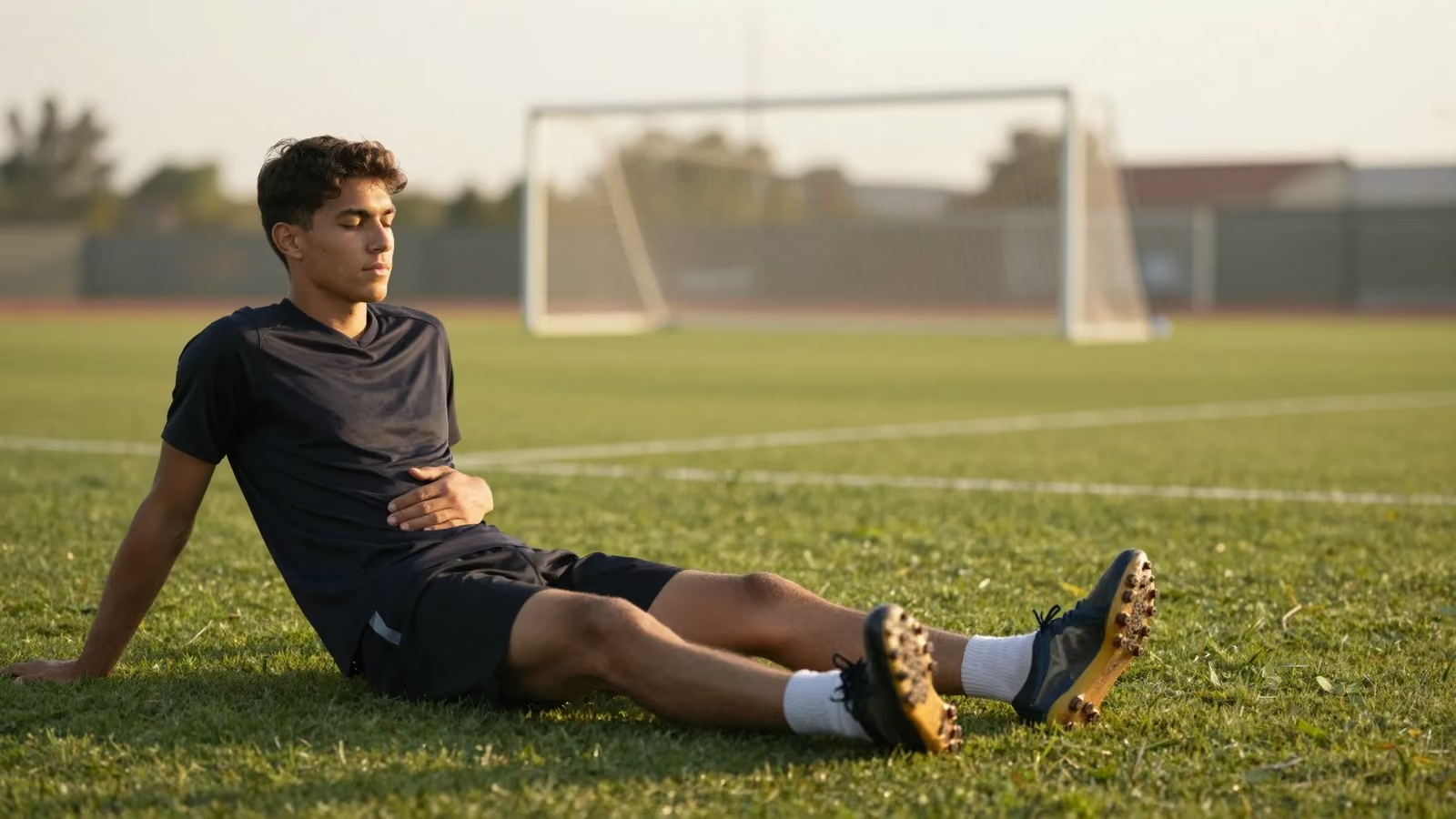
Your nervous system does not switch into rest mode the moment training ends. Heart rate drops within minutes, but in the review by Stanley et al. (2013, PMID 23912805) full recovery of parasympathetic activity took up to 24 hours after low-intensity exercise and at least 48 hours after high-intensity work. Calm breathing after exercise may speed up the first phase of that process, although the research is mixed.
Training is over. Last small-sided game, the whistle, a few minutes of easy jogging, and everyone heads to the locker room. The legs have stopped. The nervous system is still running at full speed.
How fast a player comes out of that state matters for recovery and for what he brings to the next session. That is where breathing gets interesting, because it is one of the few parts of this process you can influence directly.
Key takeaways
- Calming down takes a long time. Full parasympathetic recovery after a single aerobic session takes up to 24 h after low-intensity exercise, 24-48 h after threshold-intensity exercise and at least 48 h after high-intensity exercise (Stanley 2013).
- Heart rate recovers faster than HRV. After 10 minutes of rest, heart rate was 97.3% back to baseline, while RMSSD was only 79.8% back (Sahin 2026, older adults).
- Breathing after exercise sped up the rise in HRV. After a maximal test, two structured breathing techniques produced a faster rise in HF-HRV than spontaneous breathing, but not a faster drop in heart rate (Jones 2026).
- Not every technique calms you down. Between HIIT intervals, box breathing led to a higher heart rate and harder perceived effort than breathing at 6 breaths per minute (Kasap 2025).
- The long-term effect is uncertain. Four weeks of slow breathing after sprint training added no extra gains in fitness or HRV (Raidl 2026).
What happens to your nervous system after training?
After exercise your body shifts from sympathetic dominance, the “fight or flight” mode, back to parasympathetic dominance, the system in charge of rest and recovery. Scientists call this shift parasympathetic reactivation.
You see it first in the heart. Imai et al. (1994) showed that the drop in heart rate during the first 30 seconds after exercise depends mainly on the vagus nerve, the main pathway of the parasympathetic system. When it was blocked with medication, heart rate came down much more slowly. In well-trained cross-country skiers, that first drop was faster than in matched controls.
Stanley et al. (2013) describe what drives the process. In the first 90 minutes after exercise, the key player is probably the metaboreflex, meaning signals from acidic muscle and blood. Later, from 1 to 48 hours, the baroreflex linked to changes in plasma volume matters more. Breathing does not run this process on its own, but your heart rhythm changes with every inhale and exhale, and that is the channel through which you can influence it. We cover how breathing ties into exercise physiology in our breathing science section.
How long does it take to calm down after exercise?
Longer than your heart rate suggests. According to the review by Stanley et al. (2013), full recovery of parasympathetic activity after a single aerobic session takes:
- up to 24 hours after low-intensity exercise,
- 24-48 hours after threshold-intensity exercise,
- at least 48 hours after high-intensity exercise.
Session length seemed to matter less than intensity, although the data were limited. People with higher aerobic fitness recovered faster.
Think about a typical training week. A hard session on Wednesday, a match on Saturday, a few sessions in between. If the nervous system needs two days after a hard session, the next big stimulus often lands on a body that has not fully settled yet. How this plays out at the level of single plays, when HRV stays suppressed long after a set of sprints, is covered in breathing after a sprint: get ready for the next one faster.
One caveat. The authors stress that nervous system recovery does not line up with recovery of every other system, such as energy stores or the neuromuscular system. HRV is an important signal, not the whole recovery picture.
Does a lower heart rate mean your body has calmed down?
Not always. Heart rate can come back close to normal before heart rate variability (HRV) does, and HRV is the better window into parasympathetic activity.
Sahin and Mutlay (2026) measured this in 58 people after a 5-minute step test. After 10 minutes of passive rest, heart rate was 97.3% back to baseline. RMSSD, one of the main HRV markers, was only 79.8% back, and pNN50 was at 51.1%.
The catch: these were adults aged 60 to 81, not footballers, and the authors themselves say this is not proof of cause and effect. Still, the direction fits what you see after training. A player whose heart rate has settled does not necessarily have a settled nervous system.
Does breathing after training help calm your nervous system faster?
Early studies suggest it does, at least in the first few minutes after exercise. The effect shows up in HRV more than in heart rate itself.
The strongest data come from a recent randomized trial by Jones et al. (2026). Sixty-two military cadets completed a maximal exercise test and then recovered in one of three ways: box breathing, cyclic sighing (breathing with an extended exhale) or spontaneous breathing. In both structured breathing groups, HF-HRV rose faster from minutes 1-3 to minutes 4-6 after exercise than with spontaneous breathing. The drop in heart rate at 1 and 3 minutes was similar across all groups.
So the heart slowed down at the same rate, but the parasympathetic system regained control faster.
That fits the bigger picture. A meta-analysis by Laborde et al. (2022) found that slow breathing increases parasympathetic activity during a session, right after it and after several weeks of practice. The catch is that most of those studies were done at rest and in non-athletes. We look at how nasal breathing slows your breathing rate in nasal breathing after exercise.
It also helps to compare breathing with other recovery methods. In a meta-analysis of 17 studies, physical recovery techniques sped up the return of RMSSD (g = 0.40). Cold water immersion had the strongest effect (g = 0.75), and the benefit showed up after resistance and intermittent exercise but not after continuous cardio (Laborde 2024). How you calm down depends on what kind of training you just did.
Does every breathing technique work the same after exercise?
No. After hard exercise, some techniques can actually add stress.
Kasap and Aydin (2025) compared three ways of breathing during the rest periods of a 15-minute HIIT session on a bike in 40 active university students: spontaneous breathing, box breathing (equal phases of inhale, hold, exhale and hold) and breathing at 6 breaths per minute.
| Measure | Box breathing | 6 breaths/min | Spontaneous breathing |
|---|---|---|---|
| Heart rate after the last interval (bpm) | 164.7 | 154.8 | 159.1 |
| Perceived effort (Borg scale 6-20) | 17.3 | 15.3 | 15.3 |
Box breathing produced a significantly higher heart rate than 6 breaths per minute and a harder perceived effort than both other options. Breathing at 6 breaths per minute, however, was not significantly different from spontaneous breathing, and the time for heart rate to return to baseline was similar in all three conditions.
The takeaway is simple. When your body is hungry for air, forcing breath holds is not calming down. It is one more load.
A study by Trinkunas et al. (2026) adds another angle. Fourteen men breathed very fast for 30 seconds after each cycling bout. Their muscles reoxygenated faster and diastolic blood pressure was lower, but HRV after the session changed the same way as without the intervention: the LF component went up and HF, the vagus-linked component, went down. Fast breathing affects circulation and muscle, but it is not a calming tool.
Does a longer exhale calm you down more?
It might, but the evidence is mixed. What is more certain is that a slow breathing rate matters.
Bae et al. (2021) asked 28 people to breathe at their own natural rate, but with an exhale longer than the inhale. RMSSD and HF-HRV were higher than with equal phases, and HF-HRV stayed elevated for another 4 minutes after the task ended.
Meehan and Shaffer (2024) tested the same idea during slow breathing at 6 breaths per minute in two studies (26 and 16 people). An exhale twice as long as the inhale did not change HRV compared with equal phases. In their review of earlier work, four studies favored a longer exhale, three found no difference and two pointed to other patterns.
On the pitch it looks like this: a longer exhale helped in some studies, but it is not a magic switch. Both of these studies were done at rest, not after exercise.
What does faster calming down mean for your next session?
This is where the evidence is weakest. We know the state of your nervous system is useful for planning training load, but we do not yet know whether breathing after training improves fitness on its own.
The strongest case for “yes” is HRV as a signal. Kiviniemi et al. (2007) spent 4 weeks choosing running intensity based on morning HRV. In that group, maximal running speed rose from 15.5 to 16.4 km/h, and VO₂peak from 56 to 60 ml/kg/min. In the group with a fixed plan, speed rose from 15.1 to 15.7 km/h and VO₂peak did not change significantly. The gain in speed was significantly larger in the HRV-guided group (0.9 vs 0.5 km/h), although the difference in VO₂peak gains between groups was not significant. This was a study of 26 healthy, moderately fit men, not footballers.
On the “we don’t know” side is the study by Raidl et al. (2026). Thirty-four people did sprint interval training for 4 weeks, and half of them also did 10 minutes of slow breathing after every session and every evening. Both groups improved fitness equally, and HRV and sleep did not differ. Overnight heart rate even rose slightly in the breathing group, by 3.1 beats per minute. The authors state plainly that in this setting slow breathing offered limited value.
Between these two poles are small studies that point in a direction. In 16 athletes, an hour of calm diaphragmatic breathing after an exhausting session was linked to better antioxidant defense, lower cortisol and higher melatonin than seated rest alone (Martarelli 2011). That is only 8 people per group. We explain how the diaphragm works in a footballer in the diaphragm: football’s hidden stabilizer.
Why do you have to learn how to calm down after training?
Because a tired body naturally chooses fast, shallow breathing, and a poorly executed technique can add stress instead of removing it. The Kasap and Aydin study (2025) shows this well. Even trained participants using the wrong pattern had a higher heart rate and a harder perceived effort.
There is good news too. In 24 footballers, 10 sessions of breathing training with HRV biofeedback sped up HRV recovery after an exercise test (Yılmaz 2025). And slow breathing between sets of squats led to a bigger drop in heart rate with no loss of power (Buxton 2024). We discuss these studies in more detail in nasal breathing after exercise.
That is why at AirFlow Performance we treat calming down after exercise as a skill, not a trick for the end of a session. First a player learns calm breathing in calm conditions, then carries it into the moments right after effort, when it is hardest. Your breathing muscles also need to be ready for that work, which we cover in inspiratory muscle warm-up in football. How we build this over time is laid out in our three-stage breathing training program, and what we measured in a 7-week pilot at Lech Poznań is on our results page.
Where does the evidence end?
Studies on breathing after exercise are small, short and mostly done on bikes or treadmills, not on the pitch. We found no studies testing breathing during the cooldown after football training and its effect on the next session. That is why we say calm breathing speeds up the first phase of calming down, not that it guarantees better recovery or better form.
FAQ
How long does it take for the nervous system to recover after training? It depends mainly on intensity. According to the review by Stanley et al., full recovery of parasympathetic activity after a single aerobic session takes up to 24 hours after low-intensity exercise, 24-48 hours after threshold exercise and at least 48 hours after high-intensity exercise. People with higher aerobic fitness recovered faster (Stanley 2013).
Can breathing speed up recovery after exercise? It can speed up the first phase of calming down. After a maximal test, structured breathing produced a faster rise in HF-HRV than spontaneous breathing, although heart rate dropped at a similar rate (Jones 2026). Long-term evidence is weak: 4 weeks of slow breathing after sprint training added no extra gains in fitness or HRV (Raidl 2026).
Does a low heart rate after training mean you have fully recovered? No. Heart rate returns to normal faster than HRV, which better reflects parasympathetic activity. In 58 people, after 10 minutes of rest heart rate was 97.3% back to baseline, while RMSSD was 79.8% back (Sahin 2026). The study involved older adults, so it shows a direction, not a norm for soccer players.
Does box breathing help after intense training? The studies disagree. After a maximal test, box breathing sped up the rise in HF-HRV (Jones 2026). During the rest periods of HIIT, however, it produced a higher heart rate (164.7 vs 154.8 bpm) and a harder perceived effort than breathing at 6 breaths per minute (Kasap 2025). Holding your breath when you are hungry for air can add stress.
Does a longer exhale calm the nervous system? In some studies, yes. An exhale longer than the inhale at the same breathing rate raised RMSSD and HF-HRV (Bae 2021). During slow breathing at 6 breaths per minute, however, the inhale-to-exhale ratio did not change HRV (Meehan 2024). A slow breathing rate itself is the more reliable factor (Laborde 2022).
Can HRV help plan a footballer’s training? Research suggests it can. In a 4-week experiment, training chosen from morning HRV produced a bigger gain in maximal running speed than a fixed plan (0.9 vs 0.5 km/h), and VO₂peak rose significantly only in that group, although the difference in VO₂peak gains between groups was not significant (Kiviniemi 2007). The study involved 26 healthy, moderately fit men, not footballers.
About AirFlow Performance
AirFlow Performance runs breathing training for footballers. We ran a 7-week breathing training pilot at Lech Poznań, and today we work one-to-one with individual players.
Published: 2 November 2026
Want to know how fast your body calms down after exercise? Get in touch with AirFlow Performance
Are you part of a club or academy staff? Book a call about implementation
Sources
- Stanley J, Peake JM, Buchheit M. Cardiac parasympathetic reactivation following exercise: implications for training prescription. Sports Med, 2013. https://pubmed.ncbi.nlm.nih.gov/23912805/
- Imai K, Sato H, Hori M, Kusuoka H, Ozaki H, Yokoyama H, Takeda H, Inoue M, Kamada T. Vagally mediated heart rate recovery after exercise is accelerated in athletes but blunted in patients with chronic heart failure. J Am Coll Cardiol, 1994. https://pubmed.ncbi.nlm.nih.gov/7930286/
- Sahin G, Mutlay F. Temporal dissociation between heart rate recovery and heart rate variability recovery after submaximal exercise in healthy older adults. Eur Rev Aging Phys Act, 2026. https://pubmed.ncbi.nlm.nih.gov/42844596/
- Jones ME, Smith G, Acevedo A, Melton B. Effectiveness of Structured Breathwork Interventions on Heart Rate Variability and Heart Rate Recovery Following Maximal Exertion in Tactical Athletes. Med Sci Sports Exerc, 2026. https://pubmed.ncbi.nlm.nih.gov/41839180/
- Laborde S, Allen MS, Borges U, et al. Effects of voluntary slow breathing on heart rate and heart rate variability: A systematic review and a meta-analysis. Neurosci Biobehav Rev, 2022. https://pubmed.ncbi.nlm.nih.gov/35623448/
- Laborde S, Wanders J, Mosley E, Javelle F. Influence of physical post-exercise recovery techniques on vagally-mediated heart rate variability: A systematic review and meta-analysis. Clin Physiol Funct Imaging, 2024. https://pubmed.ncbi.nlm.nih.gov/37754676/
- Kasap M, Aydin GR. Box breathing or six breaths per minute: Which strategy improves athletes post-HIIT cardiovascular recovery? PLoS One, 2025. https://pubmed.ncbi.nlm.nih.gov/41248139/
- Trinkunas E, Kairiukstiene Z, Trinkunaite M, Poderiene K, Brazdzionyte R, Poderys J. Post-Exercise Controlled Breathing Enhances Cardiovascular Recovery and Autonomic Balance: A Randomised Crossover Study. Medicina (Kaunas), 2026. https://pubmed.ncbi.nlm.nih.gov/41752717/
- Bae D, Matthews JJL, Chen JJ, Mah L. Increased exhalation to inhalation ratio during breathing enhances high-frequency heart rate variability in healthy adults. Psychophysiology, 2021. https://pubmed.ncbi.nlm.nih.gov/34289128/
- Meehan ZM, Shaffer F. Do Longer Exhalations Increase HRV During Slow-Paced Breathing? Appl Psychophysiol Biofeedback, 2024. https://pubmed.ncbi.nlm.nih.gov/38507210/
- Kiviniemi AM, Hautala AJ, Kinnunen H, Tulppo MP. Endurance training guided individually by daily heart rate variability measurements. Eur J Appl Physiol, 2007. https://pubmed.ncbi.nlm.nih.gov/17849143/
- Raidl P, Wessner B, Laister S, Csapo R. No Evidence for the Efficacy of Slow-Paced Breathing as a Recovery Strategy After Sprint Interval Training. Int J Sports Physiol Perform, 2026. https://pubmed.ncbi.nlm.nih.gov/41569822/
- Martarelli D, Cocchioni M, Scuri S, Pompei P. Diaphragmatic breathing reduces exercise-induced oxidative stress. Evid Based Complement Alternat Med, 2011. https://pubmed.ncbi.nlm.nih.gov/19875429/
- Yılmaz E, Aktop A, Abdioğlu A, et al. The Effect of Heart Rate Variability Biofeedback on Recovery After Aerobic Exercise. Appl Psychophysiol Biofeedback, 2025. https://pubmed.ncbi.nlm.nih.gov/39630342/
- Buxton JD, et al. The Effects of Slow Breathing during Inter-Set Recovery on Power Performance in the Barbell Back Squat. J Hum Kinet, 2024. https://pubmed.ncbi.nlm.nih.gov/39132422/