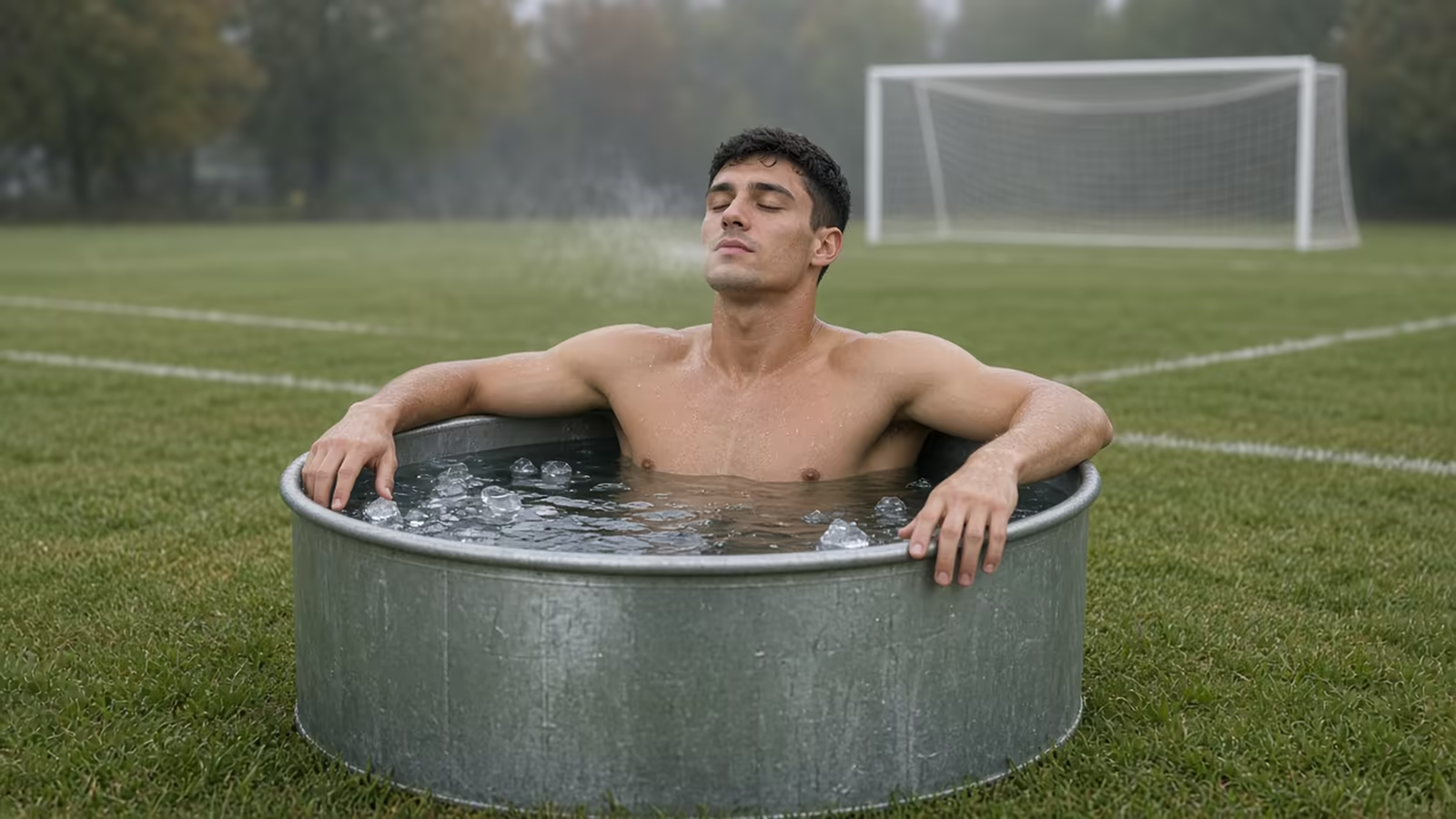
Cold water after exercise usually eases muscle soreness and improves how recovered players feel at 24 hours, but it does not always speed up the return of performance. Used regularly after strength training, it may blunt gains in muscle size and strength. An umbrella review of 15 meta-analyses (Berjisian et al., 2026, PMID 42816732) rated the certainty of this evidence as low to very low, so cold is best treated as a tool for specific situations, not a ritual after every session.
Final whistle. Dressing room, and an ice tub in the corner. Some players get in without a word, some grit their teeth and count the seconds, and someone takes three sharp, deep gasps and climbs out after a minute.
Cold water is standard in football today. The real questions are what it actually does, when it helps, when it gets in the way, and why the first thing it does is take away your control over your breathing.
Key takeaways
- Soreness and perception, yes. After high-intensity exercise, cold water reduced muscle soreness and improved perceived recovery at 24 hours (Moore 2022, 52 studies).
- Post-match performance, partly. In footballers it improved recovery of muscle strength and lowered creatine kinase, but did not change 20 m sprint performance (Veen 2026, 10 studies).
- Placebo does a lot. In 40 young footballers, cold water, hot water and a sham laser treatment produced similar recovery of performance after a simulated match (Gustafsson 2025).
- Careful after the gym. Regular immersion after resistance training reduced strength gains (SMD = -0.60), with no effect on endurance performance (Malta 2021).
- Cold hits your breathing. Sudden immersion triggers a gasp and hyperventilation, but this response can be partly controlled with instruction and habituation (Mantoni 2008, Tipton 2000).
What does cold water do to your body after training?
First comes the shock. A drop in skin temperature triggers the cold shock response: a reflex gasp, a rise in blood pressure and hyperventilation, meaning faster and deeper breathing than the body needs. Datta and Tipton (2006) describe how this respiratory response can override both conscious and automatic control of breathing.
The numbers make it clear. In 9 people immersed for 60 seconds in water at 0°C, heart rate rose within seconds from 95 to 126 beats per minute, breathing rate from 12 to 21 breaths per minute, and the volume of each breath almost doubled (Mantoni 2008).
Then comes a second phase, more interesting from a recovery point of view. In a meta-analysis of 17 studies, physical recovery techniques sped up the return of RMSSD, an HRV marker linked to the vagus nerve. Cold water immersion showed a moderate to large effect here (g = 0.75), while the other techniques showed no effect in the subgroup analysis (Laborde 2024). A review of 12 randomised trials points the same way: all of them reported parasympathetic reactivation after cold water, and six showed a significant advantage over passive recovery (Galvez-Rodriguez 2025).
You do not even need your whole body in the water. In 13 men, immersing just the face in cold water for 5 minutes after exercise sped up heart rate and HRV recovery compared with seated rest (Al Haddad 2010).
So cold stresses you first and then, shortly after, helps your nervous system shift into rest mode. How that calming process works without cold water, and how long it takes, is covered in our article on calming your nervous system after training.
Does cold water speed up recovery after a match?
Partly. It improves how players feel more than how fast they run.
The latest meta-analysis limited to footballers (Veen et al., 2026) included 10 studies with measurements 24, 48 and 72 hours after a match or simulated match. Cold water:
- improved recovery of leg muscle strength (SMD = 1.02),
- improved countermovement jump (SMD = 0.38), but only at 48 hours,
- lowered creatine kinase, a marker of muscle damage (SMD = -0.77),
- reduced muscle soreness at 24 and 72 hours (SMD = -1.04),
- did not change 20 m sprint time.
The authors add an important caveat. The prediction intervals for all outcomes included zero, so future studies may show smaller effects or none at all.
A broader meta-analysis of 52 studies in physically active people paints a similar picture. After high-intensity exercise, cold water improved muscular power, soreness, creatine kinase and perceived recovery at 24 hours, but it did not affect recovery of strength (Moore 2022).
Is the effect of cold water just placebo?
At least partly. It is the least convenient conclusion for anyone who puts an ice tub in the dressing room.
Gustafsson et al. (2025) randomised 40 national-level footballers aged 15-19 to one of three options after a 90-minute simulated match: cold water (10°C, 10 minutes), hot water (42°C, 20 minutes) or a sham laser treatment. Recovery of sprint, jump, strength and aerobic performance over 45 hours was similar in all groups. 19 players then used their recovery method in normal training for 15 weeks, about twice a week, and again there were no differences in performance development or body composition.
The same happened in 12 semi-professional footballers. A drink presented as a recovery aid produced effects similar to cold water on many measures, and both beat simple rest (Nasser 2023). The authors state plainly that the effectiveness of cold water can be explained, at least in part, by the placebo effect.
A review with graded recommendations for professional football (Querido et al., 2022) covered 39 studies. Cold water and massage were recommended for up to 72 hours after a match, but only at a perceptual level. None of the methods assessed received a recommendation for physical or physiological parameters.
That does not mean cold water does not work. It means a large part of its effect may come from the player believing in it and feeling better afterwards. On the pitch that counts too, but it is worth knowing what you are actually getting.
Do ice baths after the gym hold back your progress?
Research suggests they do, if you use them regularly after resistance training and your goal is muscle size and strength.
Roberts et al. (2015) followed 21 active men who strength trained twice a week for 12 weeks. After each session one group spent 10 minutes in cold water, the other did an active cool-down. Strength and muscle mass increased more in the group without cold water. The cross-sectional area of type II fibres, the fast-twitch ones, grew by 17% in that group, and did not change significantly in the cold water group.
Fyfe et al. (2019) gave 16 men 7 weeks of resistance training followed by either 15 minutes in water at 10°C or passive rest. Type II fibre growth was smaller in the cold water group, but maximal leg press strength increased similarly in both groups.
The meta-analysis by Malta et al. (2021) pooled 8 studies. Regular cold water after resistance training impaired gains in maximal strength and strength endurance (SMD = -0.60) and in ballistic efforts such as jumps (SMD = -0.61). After endurance training it had no effect on performance.
For a footballer this matters in practice. A pre-season block focused on strength is a different context from a week with two matches. How different training stimuli load the body is also covered in our article on breathing after a sprint and getting back to readiness.
When does cold make sense in a footballer’s week?
When a fast turnaround between efforts matters more than maximal adaptation to training.
Several reviews reach that conclusion. Kwiecien and McHugh (2021) write that cryotherapy is indicated when rapid recovery is required between bouts of exercise, as opposed to after routine training. Ihsan et al. (2021) propose a periodised approach: cold water during competition or intensified training, but not after sessions aimed at strength and muscle growth.
The umbrella review by Berjisian et al. (2026) adds one more detail. Cold water improved jump performance at 24-48 hours, but jumping was worse in the first hours after immersion. The protocols that most often worked in studies were 10-15 minutes in water at 10-15°C or 5-10°C. The authors recommend using cold water depending on context, not after every session.
Does cold water in the evening ruin your sleep?
Not in the studies we found. In one of them it even deepened sleep in the first part of the night.
In 11 cyclists, evening exercise with or without cold water did not change any sleep measure in a polysomnography study: total sleep time, time to fall asleep or the proportion of sleep stages (Robey 2013).
Chauvineau et al. (2021) compared 10 minutes in water at about 13°C in 12 runners: whole-body immersion including the head, immersion up to the hips, and no cold water. Whole-body immersion increased the proportion of deep sleep in the first 180 minutes of the night compared with hip-level immersion. Both immersion options reduced arousals compared with no cold water. Markers of fatigue and muscle damage over 48 hours, however, did not differ between conditions.
How is breathing linked to the cold response?
Directly. The first thing cold water does is force fast, uncontrolled breathing. And that is the very response you can partly control.
Mantoni et al. (2008) gave 9 people with no cold water experience thorough instructions on controlling their breathing before lowering them into water at 0°C. Their breathing still sped up, but blood flow velocity in the brain fell by a non-significant 7% on average. The authors note in their introduction that in unprepared people hyperventilation cuts it by about half. Their conclusion: even without prior cold water experience, people can suppress reflex hyperventilation.
The second mechanism is habituation. In 8 men, six 3-minute immersions in water at 15°C reduced breathing rate in the first 30 seconds of a 10°C immersion from 47 to 24 breaths per minute, and heart rate from 128 to 109 beats per minute. Seven months later the response was still significantly weaker than at the start (Tipton 2000).
Calm, slow breathing increases parasympathetic activity, as we discussed in our article on calming down after training, and the role of the nose in slowing your breathing is covered in nasal breathing after exercise. To be honest, though, we found no PubMed studies testing whether controlled breathing in cold water improves recovery in footballers. What we know is that breath control in the cold is possible, and that an uncontrolled breathing response in the first seconds is a risk described in research. Datta and Tipton (2006) describe the cold shock response as a possible precursor to drowning.
Why does breath control in the cold have to be trained?
Because the cold shock reflex is stronger than good intentions. A player stepping into ice water for the first time usually does not choose how he breathes. The reflex does that for him.
At AirFlow Performance we treat calm breathing as a skill that a player first builds in easy conditions and then carries over to moments when the body is under pressure: after a sprint, after a match and in situations like cold water. How we structure this over time is shown in our three-stage breathing training program, and what we measured in a 7-week pilot at Lech Poznań is on our results page. More on breathing physiology is in our breathing science section.
Where does the evidence end?
The umbrella review of 15 meta-analyses rated their overall methodological quality as low to critically low and the certainty of evidence as low to very low, mainly because of inconsistent and imprecise results (Berjisian 2026). The studies are small, often run in a lab, and cold water cannot be blinded, so players always know what they are getting. That is why we say cold water may help how recovered players feel after a match, not that it speeds up the return of performance for every player.
FAQ
Does cold water after training speed up recovery? Partly. After high-intensity exercise it reduced muscle soreness and improved perceived recovery at 24 hours (Moore 2022). In footballers it improved strength recovery and lowered creatine kinase, but did not change 20 m sprint time (Veen 2026). The certainty of this evidence is low (Berjisian 2026).
Do ice baths after the gym reduce muscle growth? With regular use after resistance training, research points that way. In a meta-analysis of 8 studies, cold water reduced strength gains (SMD = -0.60) but did not affect endurance training outcomes (Malta 2021). In a 12-week study, type II fibres grew only in the group without cold water (Roberts 2015).
Is the effect of cold water a placebo? Partly. In 40 young footballers, cold water, hot water and a sham laser treatment produced similar recovery after a simulated match, and 15 weeks of use did not change performance development (Gustafsson 2025). A review for professional football recommends cold water only at a perceptual level (Querido 2022).
How does cold water affect HRV? After exercise it speeds up the return of parasympathetic activity. In a meta-analysis, cold water produced a moderate to large increase in RMSSD (g = 0.75), while other techniques showed no effect in the subgroup analysis (Laborde 2024). Even face immersion alone sped up heart rate and HRV recovery (Al Haddad 2010).
Can you control your breathing in cold water? Research suggests you partly can. After thorough instruction, people with no cold water experience suppressed reflex hyperventilation in 0°C water, and brain blood flow velocity fell only non-significantly (Mantoni 2008). Six short immersions cut breathing rate in the first 30 seconds from 47 to 24 breaths per minute, with the effect lasting up to 7 months (Tipton 2000).
Does cold water in the evening make sleep worse? Not in the studies we found. In 11 cyclists, evening cold water did not change any sleep measure (Robey 2013). In 12 runners, whole-body immersion increased the proportion of deep sleep early in the night compared with hip-level immersion (Chauvineau 2021).
About AirFlow Performance
AirFlow Performance runs breathing training for footballers. We ran a 7-week breathing training pilot at Lech Poznań, and today we work one-to-one with individual players.
Published: 9 November 2026
Want to know how your breathing responds to stress and cold? Get in touch with AirFlow Performance
Are you part of a club or academy staff? Book a call about implementation
Sources
- Berjisian E, Miraftabi H, Ihsan M, Homer KA, Kendall K, Roberts L, Abbiss C. Strategic Application of Post-exercise Cold-Water Immersion to Enhance Performance Recovery and Adaptation: An Umbrella Review of 15 Published Systematic Reviews with Meta-analysis. Sports Med Open, 2026. https://pubmed.ncbi.nlm.nih.gov/42816732/
- Datta A, Tipton M. Respiratory responses to cold water immersion: neural pathways, interactions, and clinical consequences awake and asleep. J Appl Physiol, 2006. https://pubmed.ncbi.nlm.nih.gov/16714416/
- Mantoni T, Rasmussen JH, Belhage B, Pott FC. Voluntary respiratory control and cerebral blood flow velocity upon ice-water immersion. Aviat Space Environ Med, 2008. https://pubmed.ncbi.nlm.nih.gov/18717115/
- Laborde S, Wanders J, Mosley E, Javelle F. Influence of physical post-exercise recovery techniques on vagally-mediated heart rate variability: A systematic review and meta-analysis. Clin Physiol Funct Imaging, 2024. https://pubmed.ncbi.nlm.nih.gov/37754676/
- Galvez-Rodriguez C, Valenzuela-Reyes P, Fuentealba-Sepúlveda S, Farias-Valenzuela C, Salinas AE. Cold Water Immersion, Heart Rate Variability and Post-Exercise Recovery: A Systematic Review. Physiother Res Int, 2025. https://pubmed.ncbi.nlm.nih.gov/39918163/
- Al Haddad H, Laursen PB, Ahmaidi S, Buchheit M. Influence of cold water face immersion on post-exercise parasympathetic reactivation. Eur J Appl Physiol, 2010. https://pubmed.ncbi.nlm.nih.gov/19882167/
- Veen J, Bergh C, Cao Y, Randers MB, Krustrup P, Edholm P. The Impact of Cold-Water Immersion on Post-Match Recovery in Trained Soccer Players: A Systematic Review and Meta-Analysis. Scand J Med Sci Sports, 2026. https://pubmed.ncbi.nlm.nih.gov/41490103/
- Moore E, Fuller JT, Buckley JD, Saunders S, Halson SL, Broatch JR, Bellenger CR. Impact of Cold-Water Immersion Compared with Passive Recovery Following a Single Bout of Strenuous Exercise on Athletic Performance in Physically Active Participants: A Systematic Review with Meta-analysis and Meta-regression. Sports Med, 2022. https://pubmed.ncbi.nlm.nih.gov/35157264/
- Gustafsson J, Montiel-Rojas D, Romare MGA, et al. Cold- and hot-water immersion are not more effective than placebo for the recovery of physical performance and training adaptations in national level soccer players. Eur J Appl Physiol, 2025. https://pubmed.ncbi.nlm.nih.gov/40498100/
- Nasser N, Zorgati H, Chtourou H, Guimard A. Cold water immersion after a soccer match: Does the placebo effect occur? Front Physiol, 2023. https://pubmed.ncbi.nlm.nih.gov/36895634/
- Querido SM, Radaelli R, Brito J, Vaz JR, Freitas SR. Analysis of Recovery Methods’ Efficacy Applied up to 72 Hours Postmatch in Professional Football: A Systematic Review With Graded Recommendations. Int J Sports Physiol Perform, 2022. https://pubmed.ncbi.nlm.nih.gov/35961644/
- Roberts LA, Raastad T, Markworth JF, et al. Post-exercise cold water immersion attenuates acute anabolic signalling and long-term adaptations in muscle to strength training. J Physiol, 2015. https://pubmed.ncbi.nlm.nih.gov/26174323/
- Fyfe JJ, Broatch JR, Trewin AJ, et al. Cold water immersion attenuates anabolic signaling and skeletal muscle fiber hypertrophy, but not strength gain, following whole-body resistance training. J Appl Physiol, 2019. https://pubmed.ncbi.nlm.nih.gov/31513450/
- Malta ES, Dutra YM, Broatch JR, Bishop DJ, Zagatto AM. The Effects of Regular Cold-Water Immersion Use on Training-Induced Changes in Strength and Endurance Performance: A Systematic Review with Meta-Analysis. Sports Med, 2021. https://pubmed.ncbi.nlm.nih.gov/33146851/
- Kwiecien SY, McHugh MP. The cold truth: the role of cryotherapy in the treatment of injury and recovery from exercise. Eur J Appl Physiol, 2021. https://pubmed.ncbi.nlm.nih.gov/33877402/
- Ihsan M, Abbiss CR, Allan R. Adaptations to Post-exercise Cold Water Immersion: Friend, Foe, or Futile? Front Sports Act Living, 2021. https://pubmed.ncbi.nlm.nih.gov/34337408/
- Robey E, Dawson B, Halson S, Gregson W, King S, Goodman C, Eastwood P. Effect of evening postexercise cold water immersion on subsequent sleep. Med Sci Sports Exerc, 2013. https://pubmed.ncbi.nlm.nih.gov/23377833/
- Chauvineau M, Pasquier F, Guyot V, Aloulou A, Nedelec M. Effect of the Depth of Cold Water Immersion on Sleep Architecture and Recovery Among Well-Trained Male Endurance Runners. Front Sports Act Living, 2021. https://pubmed.ncbi.nlm.nih.gov/33870188/
- Tipton MJ, Mekjavic IB, Eglin CM. Permanence of the habituation of the initial responses to cold-water immersion in humans. Eur J Appl Physiol, 2000. https://pubmed.ncbi.nlm.nih.gov/11072768/